01 / ENGINEERING
Architecture matters before performance numbers do
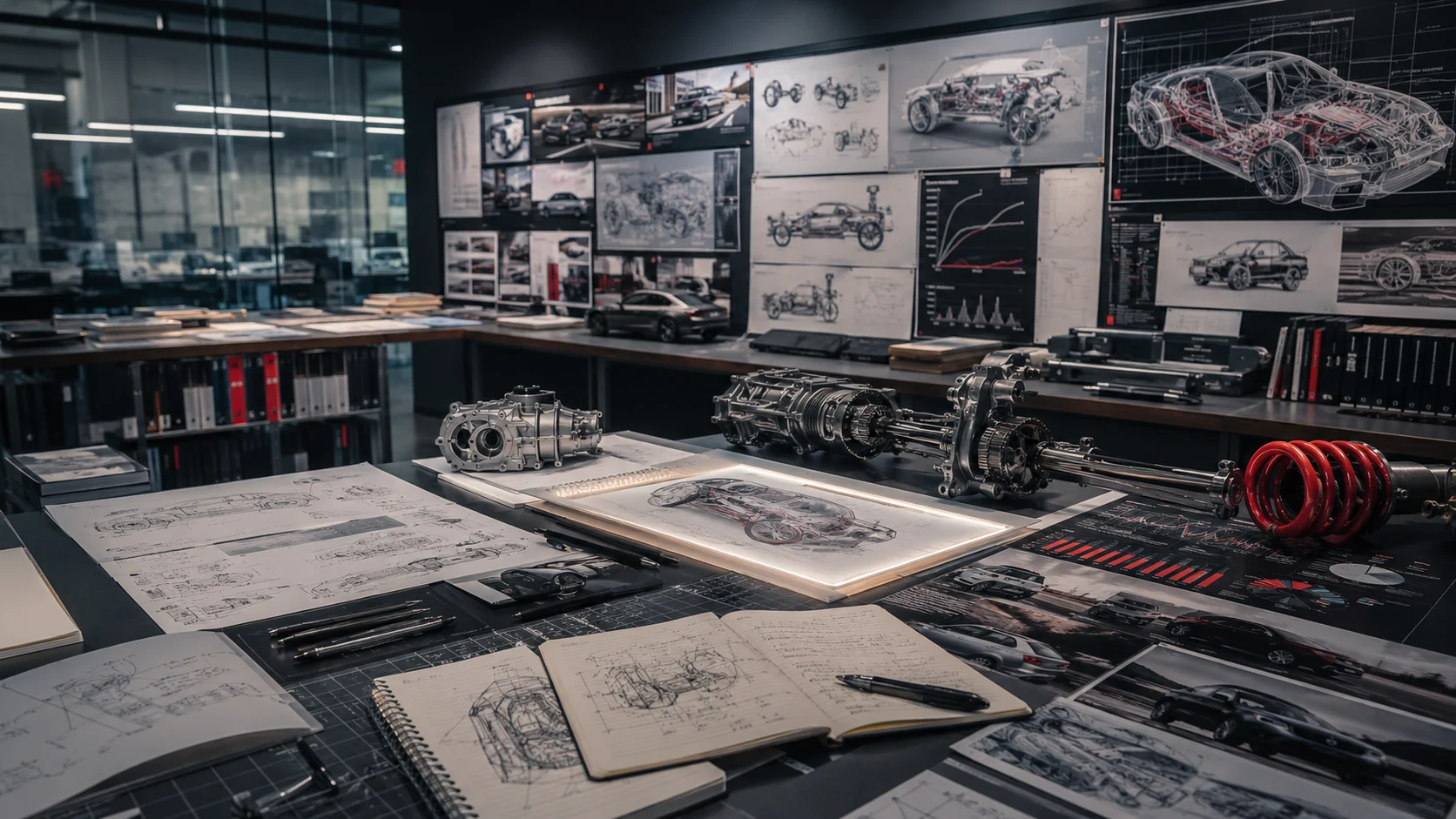
Two vehicles can produce similar headline performance while reaching it through very different engineering decisions. Packaging, suspension geometry, weight distribution, cooling, braking capacity, battery placement, transmission design, body construction, tire selection, and software calibration all influence what the driver eventually experiences. Studying those systems independently is useful, but comparative research becomes more meaningful when the systems are examined together.
A heavy electric vehicle may deliver immediate acceleration while asking more of its tires, suspension, brakes, and road surface. A compact combustion vehicle may carry less mass but introduce additional maintenance points, heat management requirements, and mechanical complexity. A commercial van can appear inefficient beside a passenger car until payload, loading geometry, service access, and utilization are included. Engineering comparisons become stronger when they explain consequences rather than simply collecting numbers.
02 / MARKET
The same vehicle can occupy completely different positions
A model considered inexpensive in one country can become a premium purchase elsewhere after import duties, registration costs, currency movement, dealer structure, transport expense, financing conditions, and local taxation are considered. Vehicle availability also changes the competitive field. A model may face dozens of rivals in one market and only a handful in another, dramatically altering how price, equipment, resale value, and brand perception are interpreted.
Used markets add another layer. Local inspection rules, corrosion, fuel prices, company-car taxation, fleet replacement cycles, repair networks, and parts supply can create very different depreciation patterns. A vehicle with mediocre resale value in one country may remain desirable elsewhere because parts are plentiful or local mechanics know it well. Market analysis therefore requires more than converting currencies and comparing manufacturer list prices.
03 / OPERATING ENVIRONMENT
Infrastructure can turn advantages into disadvantages
Road quality, parking dimensions, charging networks, fuel availability, electricity prices, climate, congestion, tolls, workshops, logistics hubs, ports, insurance systems, inspection requirements, and urban restrictions all change the usefulness of a vehicle. The same characteristic can be beneficial for one operation and prohibitive for another. A large battery may support long daily routes where charging is predictable, yet create cost and payload disadvantages for a business whose vehicles travel short distances and return to a depot frequently.
Operating conditions should therefore be treated as variables rather than background information. A delivery vehicle in central Paris, a mining support vehicle in Western Australia, a family car in Poland, and a fleet vehicle in Dubai encounter entirely different practical environments even when the underlying product is identical.
04 / USE
Ownership is a long experiment
Vehicle evaluation changes after the first week. Visibility, seat comfort, software reliability, storage details, charging routines, tire wear, service scheduling, seasonal behavior, fuel consumption, cleaning, insurance claims, parts delays, and small ergonomic decisions become more important with repeated use. Some qualities that dominate a test drive fade quickly, while seemingly minor details accumulate into significant benefits or annoyances.
Long-term research must distinguish isolated incidents from recurring characteristics. One failed sensor does not necessarily establish poor reliability, just as one unusually efficient journey does not establish typical consumption. Useful conclusions require context: mileage, environment, maintenance history, operating pattern, load, driver behavior, weather, and comparison with similar vehicles.
METHOD / COMPARISON
Comparative research should preserve differences instead of forcing universal rankings
A single league table can be attractive because it produces a clear winner, but automotive reality rarely behaves that cleanly. A vehicle can be the strongest choice for a high-mileage fleet and a poor choice for an occasional private owner. A country can offer excellent manufacturing infrastructure while imposing administrative burdens that discourage a particular business model. A technology can reduce operating expense under one energy-price structure and increase total cost under another.
CarStudies therefore treats rankings as conditional outputs rather than permanent truths. The underlying question should always be visible: best for what, under which assumptions, in which location, for how long, carrying what load, and compared with which realistic alternatives? That approach allows engineering, economics, infrastructure, manufacturing, maintenance, regulation, and actual use to occupy the same analytical framework without pretending they can be reduced to one universal score.
The site is structured as a research publication rather than a showroom. Engineering examines the physical machine. Markets examine how vehicles acquire economic meaning. Operating Environments examines the conditions surrounding automotive ownership and business activity. The research desk connects those disciplines so that comparisons can move from individual components to entire transportation systems. The aim is not to make vehicles seem more complicated than they are. It is to avoid simplifying them until the comparison stops describing reality.